Sign In

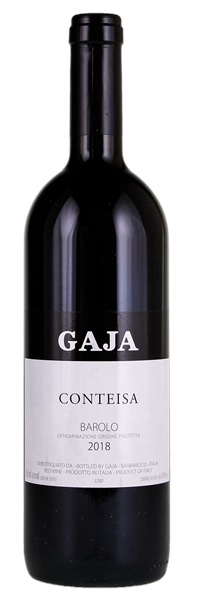
2018 Gaja Barolo Conteisa

Light label condition issue

Minimum Bid is $235
Ends Sunday, 7pm Pacific

ITEM 10582721 - Removed from a professional wine storage facility; Purchased at auction

Bidder Amount Total
$235
2018 Gaja Barolo Conteisa

RATINGS

96The Wine Advocate

...very nicely, with ripe aromas of plum, strawberry, grilled herb and chamomile flower.

96James Suckling

The fresh and just ripe strawberry aromas really come through here, together with some licorice and floral highlights. Medium to full body with fine, focused tannins that are vertical and bring your palate down through the wine. A solid and beautiful wine...

95Vinous / IWC

...elegant, gracious and classy to the core. Silky tannins and lifted, floral aromatics give this mid-weight Barolo tons of charm... Sweet red berry, pomegranate, kirsch, blood orange and mint notes...beautifully delineated. All the elements are so nicely balanced.

95Decanter Magazine (points)

The nose is highlighted by kirsch, dried cherry and earthy tones with subtle mint and peony. Cherry and strawberry dominate the fruit-driven palate, with a touch of coffee...full, with ripe tannins of great quality and moderate acidity.

93Wine Spectator

Supple and elegant, this red offers cherry, strawberry, licorice, tar and spice flavors married to a firm yet pliable structure...balanced and long overall.

PRODUCER

Gaja

Angelo Gaja’s wines are among the most distinctive in Italy, and as a businessman and winemaker, family patriarch Angelo Gaja has always been ahead of trends. A fourth-generation wine producer based in Piedmont, Gaja began advocating modern methods to improve the quality of Italian wines more than three decades ago, a time when most Italian producers were determined to simply make as much wine as possible, regardless of its quality. Like Robert Mondavi in Napa Valley, Gaja wanted his wines to be in the same league as the best wines of France. And after his careful attention to quality beginning in the 1970s, his single vineyard Barbarescos earned international attention. By dropping appellations from his labels, he was also able to create blends, which are essentially Barbarescos or Barolos with very small amounts of Barbera added. Gaja’s most famous wines are his single vineyard Barbarescos. The winery has 250 acres in vineyards.

REGION

Italy, Piedmont, Barolo

Barolo is one of Italy’s greatest wine appellations. In fact many cognoscenti of Italian wines consider Barolo to be the apex of Italian winemaking. Barolo is sometimes referred to as “the king of wines, and the wine of kings” partly because until the mid-19th century Piedmont was owned by the noble House of Savoy, the historic rulers of northwestern Italy. And the Savoys had a taste for Nebbiolo. Nestled into the rolling hills of Langhe, the Barolo DOCG includes 11 communes, one of which is the town of Barolo. There are 4,200 vineyard acres in the appellation and since the late 19th century growers have tried to identify their best vineyards. By marketing some vineyards as better quality than others, Barolo producers have followed the Burgundian custom of making single vineyard, or “cru” vineyard bottlings. As in neighboring Barbaresco, the Barolo DOCG requires that wines be 100% Nebbiolo, a grape thought of as the Pinot Noir of Italy. Records show that Nebbiolo was grown in the Piedmont as early as the 14th century, and despite being somewhat finicky – it is late to ripen and easily damaged by adverse weather --- Nebbiolo makes highly aromatic and powerful red wines. Until the mid-19th century Nebbiolos of Piedmont were vinified as sweet wines, though that ended in the late 19th century when a French oenologist was invited to Piedmont to show producers how to make dry reds. Barolo was made a DOC in 1966 and upgraded to DOCG status in 1980. Barolos must be aged at least three years, at least two of those years in wood. Barolos are tannic and robust and generally need at least five years to soften into complex, earthy wines.

TYPE

Red Wine, Nebbiolo, D.O.C.G.

This red grape is most often associated with Piedmont, where it becomes DOCG Barolo and Barbaresco, among others. Its name comes from Italian for “fog,” which descends over the region at harvest. The fruit also gains a foggy white veil when mature.