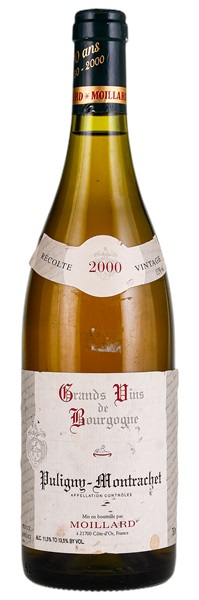
Moillard is an historic name in the Côte d’Or. But as a label it has often been confusing. The domaine started in 1848 when a young man named Symphorien Moillard married Margueritte Grivot, the daughter of a vineyard owner. In the many generations since then new vineyards were acquired, older parcels divided up for inheritance, and in true Burgundian style labels were often modified to reflect generational changes in the management of the domaine, or new parts of the domaine. Labels have included Thomas-Moillard, Moillard, Moillard-Grivot and Maison Moillard. By the early 21st century the estate had become a major player in the Côte d’Or, as a producer and a negociant. However today the Moillard extended family no longer owns the domaine or the maison. With more than 65 shareholders, most of them family members, disagreements arose and in 2005 some 30 acres of prime vineyards were sold off to Domaine Dujac and Etienne de Montille. In 2008 the remainder of Molliard was sold to Vincent Sauvestre, a major producer, negociant and land owner in Burgundy and elsewhere. Sauvestre owns the negociant Jean-Baptiste Béjot and more than 740 acres throughout Burgundy, Provence and Languedoc. Under Béjot ownership, Domaine Moillard produces Premiers Crus and village wines from a 75-acre property located between Vougeot and Volnay.
Puligny-Montrachet, according to Burgundy writer Clive Coates, “is the greatest white wine commune on earth.” Though other reviewers are not always as extravagant in their praise, there is no question that the appellation’s wines are generally the most lauded Chardonnays in the world. Puligny-Montrachet the commune is tiny, with fewer than 500 residents. Yet the appellation named for it has 1,250 acres of vineyards, including 76 acres of Grands Crus and 247 acres of Premiers Crus. Its four famous Grands Crus are Montrachet, Chevalier-Montrachet, Bâtard-Montrachet and Bienvenues-Bâtard-Montrachet. There are 26 Premiers Crus completely or partly in the appellation. The Premiers and Grands Crus vineyards are on slopes that eventually rise to 1,300 feet and become total rock. In his admiration for this appellation, Coates added “The top Montrachets, Chevaliers and Bâtards are wines to drink on bended knees, with heartfelt and humble thanks.”
This white variety originated in Burgundy, but is now grown around the world. Its flexibility to thrive in many regions translates to wide flavor profile in the market. Chardonnay is commonly used in making Champagne and sparkling wines.

 Preferred storage and shipping partner of
 Share
Share
 Post
Post
 Tweet
Tweet
 Copy Link





 <
<
 >
> service@winebid.com
 (888) 638-8968