Sign In

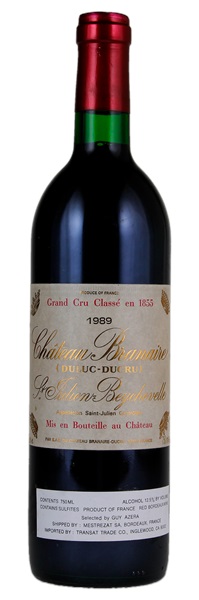
1989 Château Branaire-Ducru

Light capsule condition issue; base neck fill; light label condition issue; light writing on label

Removed from a temperature and humidity controlled wine cellar; Purchased upon release; Consignor is original owner
Ends Sunday, 7pm Pacific

RATINGS

92Robert M. Parker Jr.

The wine is currently revealing more expansiveness, fuller body, and plenty of lusty richness, a sure-fire formula for producing a crowd pleaser. There are no hard edges to this opulently-textured, rich, ripe, complex, savory style of wine.

91Vinous / IWC

Earthy nuances complicate ripe red fruit aromas on the rather woodsy nose. Then fresh and clean on the palate...

90Wine Spectator

Harmonious, balanced and very fresh '89. Color is medium-dark ruby, with lovely fresh floral and raspberry aromas. Medium- to full-bodied, well-integrated tannins and a fruity, minty aftertaste.

PRODUCER

Château Branaire-Ducru

Château Branaire-Ducru is a Fourth Growth Bordeaux according to the official classification of 1855. The 123-acre estate is in St.-Julien-Beychevelle, on the left bank of the Gironde River. It is owned by the Marotteaux family and produces up to 180,000 bottles annually of its Château Branaire Ducru. The vineyards are planted to 70% Cabernet Sauvignon, 22 % Merlot, 4% Cabernet Franc and 4% Petit Verdot. The estate dates back to the late 17th century, when it was acquired by Jean-Baptiste Braneyre. Robert M. Parker Jr. has written that Branaire is “largely ignored by speculators, (but) is favored by wine drinkers…The finest vintages are magnificently scented, deep, rich wines that are as good as other top wines of St. Julien.” The estate's second wine is Duluc de Branaire-Ducru.

REGION

France, Bordeaux, St.-Julien

Saint-Julien is the smallest of the four main Médoc appellations with 2,175 acres of vineyards. It is just south of Pauillac on the left bank of the Gironde, and although it has no First Growth châteaux, its 11 Classified Growth estates are widely admired. Robert M. Parker Jr. has written that winemaking in Saint-Julien from all classifications “is consistently both distinctive and brilliant.” He adds it is Médoc’s “most underrated commune.” The best-known estates are Léoville Las Cases, Ducru-Beaucaillou, Léoville Poyferré, Léoville Barton and Gruaud Larose, and most of those have riverside estates. The soil in this appellation is gravelly with clay. Cabernet Sauvignon is the main grape grown, and it is blended with Cabernet Franc, Merlot and sometimes small amounts of Petit Verdot.

VINTAGE

1989 Château Branaire-Ducru