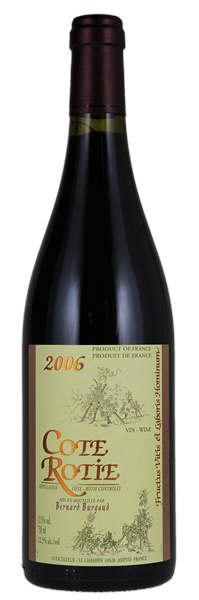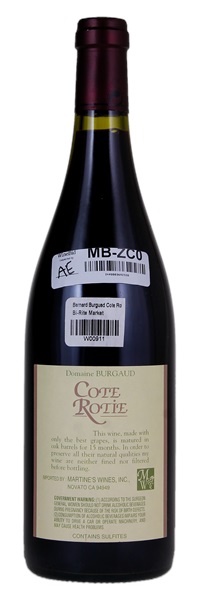
Solid, with brawny grip at the core of black currant, crushed fig, coffee, macerated olive and mesquite notes. The long, briary, iron-filled finish will need some cellaring to stretch out fully.
Smoky red and dark berry aromas are complicated by violet, cured meat, anise and minerals. Textbook Cote-Rotie on the nose as well as the palate, which offers sweet raspberry and cassis flavors complicated by tobacco and candied licorice..
The Northern Rhône Valley wine region hugs the Rhône River from Vienne in the north to Valence at its southern tip. The French call the region Côtes du Rhône Septentrionales, and it is divided into eight appellations. Along with its neighbor to the south, the Southern Rhone Valley, it is famous for its big, tannic, intensely concentrated wines. Syrah is the only red grape permitted in AOC wines from this sub-region, though the Syrah can be blended with the white wine grapes Viognier, Marsanne and Roussanne, depending on the regulations for each AOC. White wines are made from Viognier, Marsanne and Roussanne. Of the eight appellations in the north, the most admired wines tend to come from Côte-Rôtie, Condrieu and Hermitage, though there are certainly exceptional wines to be found in St. Joseph, Crozes-Hermitage, St.-Peray, Crozes-Hermitage and Cornas. Along with Bordeaux, Burgundy and Champagne, Rhône wines are among France’s best known and most collected wines. Red wines from these appellations are notable for their signature aromas of bacon and green olives, and for their depth. Robert M. Parker, a great champion of Rhone wines, has written that “the northern Rhône produces three of the greatest wines in the world – the white wines of Condrieu and the red wines of Côte-Rôtie and Hermitage.”
This grape is grown in milder climates and produces a medium-to full-bodied wine. It is also known as Shiraz, but should not be confused with Petit Sirah, which was developed by crossing Syrah with Peloursin.