Sign In

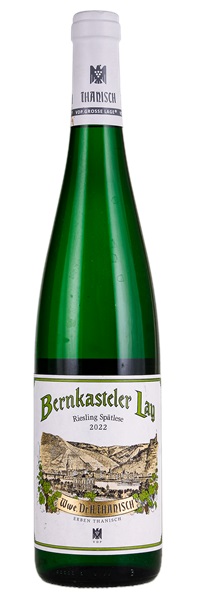
2022 Dr. H. Thanisch Bernkasteler Lay Riesling Spatlese #15

Not Currently In Auction

Latest Sale Price

February 22, 2026 - $33

Estimate

RATINGS

95James Suckling

What a beautiful peachy nose this has, with also a slew of white-flower aromas and a touch of orchid. Pure and silky on the medium-bodied palate, this is very subtle and filigree. Ripe through and through, yet no hint of heaviness whatsoever. Rather, it is super-precise and delicate at the very long, complete finish.

93Vinous / IWC

...slightest slate and citrus notions...palate is gently sweet, bringing in greengage compote sweetness, fresher, crunchy greengage and some lemon...fine-boned and gently sweet, very sonorous, very harmonious and serene in a way. It is gentle and long on a smooth, elegant body at around 65g/L of residual sweetness. (Sweet)

PRODUCER

Dr. H. Thanisch

Dr. H. Thanisch (Muller–Burggraef) is 34-acre estate in Germany’s Mosel Valley. The estate was founded by Dr. Hugo Thanisch in 1785 and is owned by Barbara Rundquist-Muller. It is known for its Riesling, though it has also started to produce Pinot Noir.

REGION

Germany, Mosel-Saar-Ruwer

Mosel-Saar-Ruwer is Germany’s most prestigious wine region and it is comprised of the vineyards surrounding the Mosel River and its tributaries, the Saar and Ruwer. This region is the northernmost of Germany’s primary viticultural areas, located on the western edge of Germany just above the northeast corner of France. Internationally Mosel Rieslings are considered among the finest white wines in the world. In Germany and elsewhere, the region’s name is often shortened simply to Mosel, and in fact since 2007 Mosel has been the formal name of the region for viticultural purposes. The references to Saar and Ruwer were dropped for ease of marketing. The distinctively crisp, mineral tasting, acidic Rieslings produced in Mosel are attributed partly to the region’s slate soils and extremely vertiginous vineyards. Many vineyards are on 60 to 80 percent cent inclines along the three rivers. Riesling grapes represent more than half of all the grapes grown in Mosel, followed by Muller-Thurgau, a white wine grape related to Riesling, and Elbling, an indigenous white wine grape often used for sparkling wines.

TYPE

White Wine, Riesling, Spätlese

This white variety originated in Germany. It’s known for its strong flowery aromas and high acidity. Please note Rieslings can have dramatic differences as the grape can be used to make dry, semi-sweet, sweet and sparkling wines.

VINTAGE

2022 Dr. H. Thanisch Bernkasteler Lay Riesling Spatlese #15