Sign In

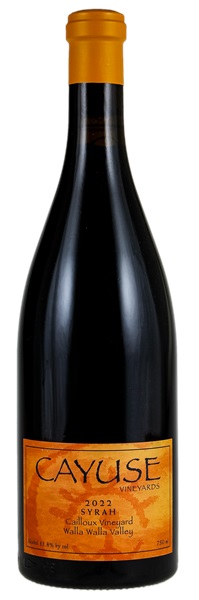
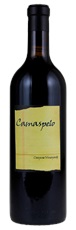
2022 Cayuse Cailloux Vineyard Syrah

Lightly elevated cork

Removed from a subterranean, temperature and humidity controlled residential cellar

Ends Sunday, 7pm Pacific

RATINGS

98Jeb Dunnuck

Potent spicy black cherry, crushed gravel, and black tea ride a focused, precise palate of medium-bodied intensity that’s dark, spicy, and feral, lengthy and dense, with a freshness to the long finish.

98Owen Bargreen

...bursts out of the glass with gorgeous high-tones...as alluring honeysuckle and pink grapefruit blossom notes mingle alongside shades of BBQ beef ribs, seaweed and rich roasted figs...palate is plush and seamless with serious verve and texture. Very stony, floral and complex...

96James Suckling

Complex...offers a broad spectrum of aromas. Smoked meat, black olives, crushed violets and thyme are layered with blackberries and a hint of iodine...palate is deep and structured, balancing juicy acidity with fine but broad and dusty tannins. The savory finish lingers, showing cracked pepper and turned earth.

95Wine Spectator

Shows presence and detail, offering compelling flavors of raspberry and blueberry that draw in licorice, garrigue, crushed stone and black olive accents as this gathers richness and tannins on the finish.

PRODUCER

Cayuse

Cayuse, in Walla Walla Valley, was founded in 1997 by Christophe Baron, a native of France. He grew up in a family of vignerons in Champagne and could have had a life making elegant Champagnes. Instead, Baron today is known as a brash trailblazer with an instinct for undiscovered terroir and a talent for producing big, delicious Syrahs. Baron studied viticulture in Burgundy and Champagne, and had ambitions to make Pinot Noir in Oregon. But on a trip to the U.S. in the late 1990s he happened to stop in Walla Walla, where south of the city he discovered property he believed would be perfect for growing grapes. The dry soil was partly composed of rocks the size of potatoes, and it reminded Baron of Châteauneuf -du-Pape. Though there had been no vineyards in the area since 1956, Baron purchased land and planted vineyards. He now owns 60 acres in what recently became Washington’s newest AVA, the Rocks District of Milton-Freewater. Baron grows mostly Syrah, along with some Cabernet Franc, Cabernet Sauvignon, Grenache, Merlot, Tempranillo and Viognier. Baron is an advocate of biodynamic, or chemical-free agriculture, and Cayuse is biodynamic. Cayuse’s signature wines are Syrahs, which often come with fanciful names, such as Bionic Frog Syrah, and outstanding ratings. Cayuse Syrahs are considered among the most collectible Washington wines. Baron also is involved with several other unorthodox winemaking ventures in Washington. He owns Horsepower, a Walla Walla estate where he uses Belgian draft horses instead of tractors, and he is one of the owners of No Girls Wines, which is a collaboration between Baron and some of his Cayuse employees. The name No Girls comes from a hand-painted sign found on the side of an historic building that Baron and his partners acquired in downtown Walla Walla. The building was once home to a brothel, but the sign went up to signal the end of that era.

REGION

United States, Washington, Walla Walla Valley

Walla Walla Valley AVA likes to call itself the Napa Valley of Washington, and given the concentration of well-reviewed wineries in the appellation, the comparison is understandable. The Walla Walla appellation is comprised of 340,000 acres, of which 1,200 acres are vineyards. Walla Walla is located in the southeastern corner of Washington and it extends slightly into northeastern Oregon. It is named after the Walla Walla River Valley, and the city of Walla Walla is the commercial center of Washington’s wine industry. The city was founded in the 1840s by the Hudson’s Bay Company as a trading post, but as early as the 1850s farmers were planting grapes for winemaking. Prohibition shuttered winemaking in the early 20th century, but a winemaking renaissance started in the 1970s when Leonetti Cellars, still one of the state’s most acclaimed wineries, started producing acclaimed Cabernet Sauvignon. Walla Walla’s AVA status was awarded in 1984 and today there are more than 100 wineries. Cabernet Sauvignon is the most frequently planted grape, followed by Merlot, Syrah, Cabernet Franc, Sangiovese Chardonnay and Viognier.

TYPE

Red Wine, Syrah (Shiraz)

This grape is grown in milder climates and produces a medium-to full-bodied wine. It is also known as Shiraz, but should not be confused with Petit Sirah, which was developed by crossing Syrah with Peloursin.

VINTAGE

2022 Cayuse Cailloux Vineyard Syrah