Sign In

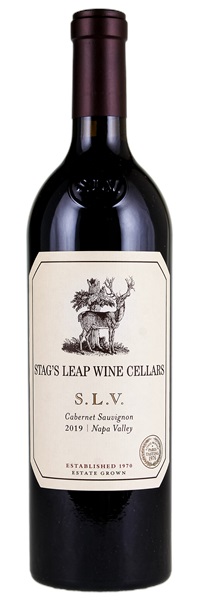
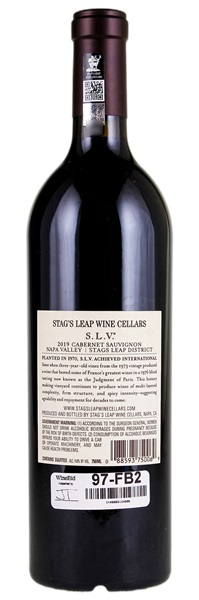
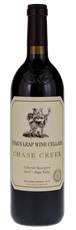
2019 Stag's Leap Wine Cellars SLV Cabernet Sauvignon

Removed from a professional wine storage facility

Ends Sunday, 7pm Pacific

RATINGS

99Wine Enthusiast

...has beautiful perfume on the nose, and a supple yet firm structure. Dusty plum, dried herb and clove spice are interwoven between tangy cassis and notes of crushed rock.

96James Suckling

Deep yet floral nose with pure cassis, blackberry and blueberry concentrate, as well as hints of sandalwood and pine. Quite ample on the palate, laden with velvety tannins in a mealy form. Rich and primary, yet juicy and supple.

95The Wine Advocate

...features perfumed aromas of violets and cassis...medium to full-bodied on the palate, nicely elegant while being powerful and sturdy at the same time...subtle herb shadings and a long, silky finish.

95Vinous / IWC

Intense blue fruit, gravel, menthol, lavender and pencil shavings confer gravitas.

95+ Jeb Dunnuck

Pure crème de cassis, violets, and lead pencil shaving...has terrific balance as well as a great mid-palate. Possessing youthful tannins and remarkable purity of fruit...

93.2CellarTracker

PRODUCER

Stag's Leap Wine Cellars

It was a 1973 Stag’s Leap Cabernet Sauvignon that came in first at the now famous 1976 Paris Tasting, the blind tasting of Bordeaux and California Cabernet Sauvignon set up by the English wine merchant Steven Spurrier. The story of the tasting, made into films and books, is now part of the coming-of-age story of Napa Valley wines, and Stag’s Leap will forever hold the title of the little California winery that could. Today the estate is also known as a leader in organic and sustainable winemaking, and it continues to win prestigious international awards for its wines. (Chateau Montelena’s 1973 Chardonnay won the first-place award for white wines at the tasting, meaning that in a blind tasting by French judges California wines won first place in both the red and white wine categories.) Founded in 1972 by Warren and Barbara Winiarski, the winery is in the Stags Leap district of Napa Valley. In 2007 the Winiarski family sold it to a joint venture of Chateau St. Michelle in Washington state and Marchesi Antinori of Italy. It is also partly owned by Altria, the tobacco/food conglomerate.

REGION

United States, California, Napa Valley

Napa Valley AVA is the most famous winemaking region in the United States and one of the most prestigious in the world. With nearly 43,000 acres of vineyards and more than 300 wineries, it is the heart of fine wine production in the United States. Winemaking started in Napa in 1838 when George C. Yount planted grapes and began producing wine commercially. Other winemaking pioneers followed in the late 19th century, including the founders of Charles Krug, Schramsberg, Inglenook and Beaulieu Vineyards. An infestation of phylloxera, an insect that attacks vine roots, and the onset of Prohibition nearly wiped out the nascent Napa wine industry in the early 20th century. But by the late 1950s and early 1960s Robert Mondavi and other visionaries were producing quality wines easily distinguishable from the mass-produced jug wines made in California’s Central Valley. Napa Valley’s AVA was established in 1983, and today there are 16 sub-appellations within the Napa Valley AVA. Many grapes grow well in Napa’s Mediterranean climate, but the region is best known for Cabernet Sauvignon. Chardonnay is also very successfully cultivated, and about 30% of the AVA’s acreage is planted to white grapes, with the majority of those grapes being Chardonnay,

TYPE

Red Wine, Cabernet Sauvignon

One of the most widely grown grape varieties, it can be found in nearly every wine growing region. A cross between Cabernet Franc and Sauvignon Blanc. It’s a hardy vine that produces a full-bodied wine with high tannins and great aging potential.

VINTAGE

2019 Stag's Leap Wine Cellars SLV Cabernet Sauvignon