Sign In

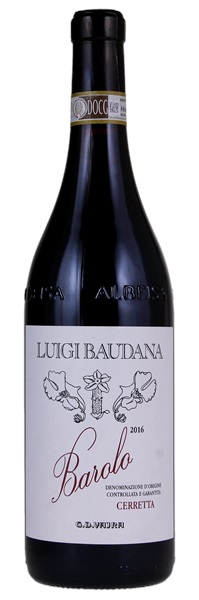
2016 Luigi Baudana Barolo Cerretta

Not Currently In Auction

Latest Sale Price

May 4, 2025 - $71

Estimate

RATINGS

96The Wine Advocate

...unfolds slowly in the glass to reveal orange peel, blue flower and camphor ash. There is generous black fruit in there as well, carefully woven into the greater texture of the wine. The tannins are accessible and integrated...

95Vinous / IWC

Black cherry, lavender, scorched earth, cloves, leather and a range of balsamic notes give the Cerretta its somber, virile feel. Ample and powerful yet also medium in body, the Cerretta captures so much of what makes Nebbiolo so captivating, specifically the ability for a wine to constantly transform in the glass.

95Wine Enthusiast

...full-bodied firmly structured wine opens with aromas of ripe dark-skinned berry, rose petal, new leather and eucalyptus. Showing its Serralunga pedigree, it features tightly wound, noble tannins that provide assertive but seamless support for juicy Marasca cherry, crushed raspberry, tobacco and licorice before a minty close.

17+ Jancis Robinson

Enticing, focused cherry nose mingled with minerally notes. Soft and gentle yet supple palate with fine, grainy tannins lining the fruit. Elegant and yet with plenty of substance.

PRODUCER

Luigi Baudana

Luigi Baudana is a 10-acre estate in Langhe. For 30 years it was owned and operated by Luigi Baudana and his wife Fiona. Baudana’s family has been making wine in Serralunga d’Alba for many generations. In 2008 Baudana sold most of his interest in the estate to the Vajra family, who run the commercial side of the business. Baudana still is winemaker, however, and the estate remains highly admired among Barolo cognoscenti. Luigi Baudana also makes a white blend of Chardonnay, Sauvignon Blanc, Riesling and Nascetta. About 800 cases are of Barolo are produced annually.

REGION

Italy, Piedmont, Barolo

Barolo is one of Italy’s greatest wine appellations. In fact many cognoscenti of Italian wines consider Barolo to be the apex of Italian winemaking. Barolo is sometimes referred to as “the king of wines, and the wine of kings” partly because until the mid-19th century Piedmont was owned by the noble House of Savoy, the historic rulers of northwestern Italy. And the Savoys had a taste for Nebbiolo. Nestled into the rolling hills of Langhe, the Barolo DOCG includes 11 communes, one of which is the town of Barolo. There are 4,200 vineyard acres in the appellation and since the late 19th century growers have tried to identify their best vineyards. By marketing some vineyards as better quality than others, Barolo producers have followed the Burgundian custom of making single vineyard, or “cru” vineyard bottlings. As in neighboring Barbaresco, the Barolo DOCG requires that wines be 100% Nebbiolo, a grape thought of as the Pinot Noir of Italy. Records show that Nebbiolo was grown in the Piedmont as early as the 14th century, and despite being somewhat finicky – it is late to ripen and easily damaged by adverse weather --- Nebbiolo makes highly aromatic and powerful red wines. Until the mid-19th century Nebbiolos of Piedmont were vinified as sweet wines, though that ended in the late 19th century when a French oenologist was invited to Piedmont to show producers how to make dry reds. Barolo was made a DOC in 1966 and upgraded to DOCG status in 1980. Barolos must be aged at least three years, at least two of those years in wood. Barolos are tannic and robust and generally need at least five years to soften into complex, earthy wines.

TYPE

Red Wine, Nebbiolo, D.O.C.G.

This red grape is most often associated with Piedmont, where it becomes DOCG Barolo and Barbaresco, among others. Its name comes from Italian for “fog,” which descends over the region at harvest. The fruit also gains a foggy white veil when mature.

VINTAGE

2016 Luigi Baudana Barolo Cerretta