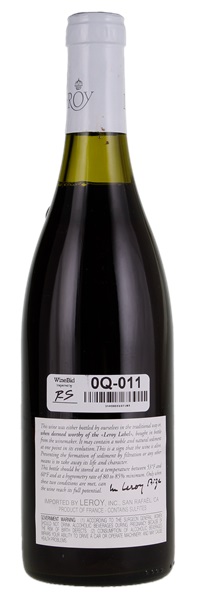
Maison Leroy is often called the greatest estate in Burgundy. Its wines are legendary, as is its history. Founded in 1868 by Francois Leroy in Vosne-Romanee, the Leroy name was associated with outstanding wine by the late 19th century. In 1942 the family purchased half of Domaine de la Romanee-Conti. Today the estate is run by the remarkable Lalou Leroy, who ran the family’s negociant business for decades before taking over winemaking in 1988. She added vineyards to the estate and today has 56 acres of prime parcels planted to Pinot Noir, Chardonnay and Aligote. About 17 of her acres are in grand cru vineyards, including Corton-Charlemagne, Corton-Renardes, Richebourg, Romanee-St. Vivant, Clos de Vougeot, Musigny, Clos de la Roche, Latricieres-Chambertin and Chambertin. Robert M. Parker Jr. has called Leroy’s wines “the reference point for Burgundy…(the wines) are among the noblest and purest expressions of Pinot Noir and Chardonnay in Burgundy.”
Pernand-Vergelesses is an 870-acre appellation sometimes overshadowed by its famous neighbor to the east, Aloxe-Corton. Depending on the time of the day, Le Montagne de Corton literally casts a shadow over of the village of Pernand-Vergelesses, which has fewer than 400 people. Pernand-Vergelesses appellation wines can be red or white, and its most renowned wines are the Grand Crus it shares with its neighbor Aloxe-Corton. About 25% of the Grand Cru vineyard Corton-Charlemagne is within the Pernand-Vergelesses appellation. There are six Premiers Crus, they produce much of the wine of Pernand-Vergelesses and nearly 75% of what they produce is Pinot Noir. Many of the vineyards face northeast, meaning that inhospitable weather can be particularly challenging for growers. Robert M. Parker Jr. notes “in good vintages a top Premier Cru Pernand-Vergelesses will be a relatively rich, rustic, concentrated wine that is often compared to that of its nearby neighbor, Savigny-Lès-Beaune.”
This red wine is relatively light and can pair with a wide variety of foods. The grape prefers cooler climates and the wine is most often associated with Burgundy, Champagne and the U.S. west coast. Regional differences make it nearly as fickle as it is flexible.


 Preferred storage and shipping partner of
 Share
Share
 Post
Post
 Tweet
Tweet
 Copy Link


 <
<
 >
> service@winebid.com
 (888) 638-8968