Sign In

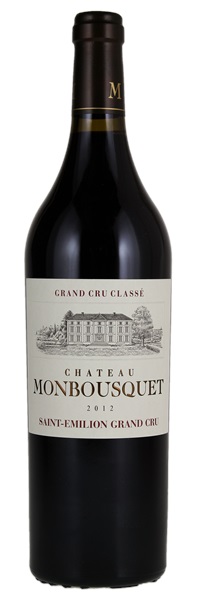
2012 Château Monbousquet

Not Currently In Auction

Latest Sale Price

December 14, 2025 - $46

Estimate

RATINGS

93Wine Spectator

A horse of a different color, with savory and sage notes streaking past the well-endowed core of glistening plum, blackberry and boysenberry fruit. A polished mesquite edge frames all the elements, while the finish glides on.

92James Suckling

This is really soft and fine for Monbousquet. Full body, ultra-fine tannins and a chocolate, vanilla bean and berry character. Very fine. 60% merlot, 30% cabernet franc and 10% cabernet sauvignon.

91Vinous / IWC

...pliant and expressive, with silky, suave tannins framing the forward, red-fleshed stone fruits. Sweet floral and spice notes add aromatic lift on the feminine finish.

90Robert M. Parker Jr.

It is medium-bodied, with light tannin in a very approachable style...very well-balanced...

15Jancis Robinson

PRODUCER

Château Monbousquet

Château Monbousquet is an 81-acre estate in the St.-Émilion appellation. It became a Grand Cru Classé A in the 2006 St.-Émilion classification. The estate dates back centuries, and wine was first produced in the 19th century. By the early 20th century it was in disrepair, but Daniel Querre bought it in 1945 and made restorations and improved the wine. In 1993 Monbousquet was bought by Gerard Perse, a former professional cyclist and supermarket magnate who now owns numerous wine estates, including Pavie, Pavie-Decesse and La Clusière. Influential consultant Michel Rolland has been involved with the winemaking since Perse bought the estate. Vineyards are planted to 60% Merlot, 30% Cabernet Franc and 10% Cabernet Sauvignon. About 80,000 bottles are produced annually. The second label is Angelique de Monbousquet. Robert M. Parker Jr. has written that since Perse acquired the property, Monbousquet “has been one of the stars of its appellation as well as one of Bordeaux’s most exotic offerings.”

REGION

France, Bordeaux, St.-Émilion

Saint-Émilion is on the east side of the Dordogne River. At 13,400 acres it is one of Bordeaux’s largest appellations, and perhaps its most picturesque. It is also home to what has been called “the garagiste” movement of upstart, tradition-defying winemakers who produce artisanal wines in styles that are unconventional for the appellation. The village of Saint-Émilion dates from the middle ages and it sits on low hills, surrounded by ancient walls. Like its neighbor Pomerol, Saint-Émilion was not included in the famous Bordeaux classification system of 1855. But a century later a ranking system was put in place, and unlike the classification system for the Medoc, the Saint-Émilion system is reviewed every ten years, meaning that estates can be upgraded or downgraded. There are three rankings: Grand Cru Classé, Premier Grand Cru Classé B and Premier Grand Cru Classé A, with the final ranking being the best. Such legendary Saint-Émilion estates as Châteaux Ausone and Cheval-Blanc are Premier Grand Cru Classé A, along with Châteaux Pavie and Angélus, both added to the classification in 2012. Wines in this appellation are primarily Merlot, mixed with Cabernet Franc and Cabernet Sauvignon.

VINTAGE

2012 Château Monbousquet