Sign In

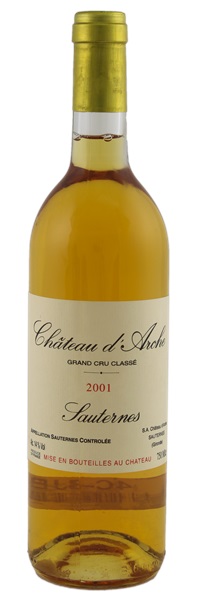
2001 Château d'Arche

Light capsule condition issue; light label condition issue

Removed from a subterranean, temperature and humidity controlled residential cellar; Purchased at retail
Ends Sunday, 7pm Pacific

RATINGS

95Wine Spectator

Bright and aromatic, with passion fruit, mango and lemon on the nose. Just a hint of honey. Full-bodied, very sweet and very intense, with vanilla, botrytis, spice and piecrust. Best ever from this estate.

90Robert M. Parker Jr.

With loads of glycerin and fat, the 2001 d’Arche reveals elegant aromas of honeysuckle, orange marmalade, honeyed lemon, and a hint of coconut as well as good acidity, medium to full body, and obvious botrytis.

PRODUCER

Château d'Arche

Château d’Arche is a 100-acre estate in Sauternes. It is named for the Comte d’Arche, who owned the estate in the late 18th century. After the French Revolution it was divided and sold. In the 1960s some of the best vineyards were brought back together and in the 1980s the estate came under the direction of the late Pierre Perromat, former head of the INAO, the French institute that regulates the awarding of designation of origin status for agricultural products, including wine. Perromat revitalized the estate and Robert M. Parker Jr. wrote in 2003 that “the style of wine produced at d’Arche offers very unctuous, rich fruit, no doubt because of the high percentage of Semillon, but also because of the late harvesting and the proprietor’s serious commitment…the wine is impeccably well made.” The second wine is Prieuré d’Arche.

REGION

France, Bordeaux, Sauternes

Sauternes makes the world’s most famous dessert wines. Though the appellation lies within the Graves region of Bordeaux’s left bank, the appellation makes only sweet wines from white grapes, primarily Semillon sometimes blended with small amounts of Muscadelle. The five communes within Sauternes are Barsac, Bommes, Fargues, Preignac and Sauternes. Barsac also has its own appellation and, typically, Barsac wines are slightly drier and lighter than other Sauternes. Sauternes are made when weather conditions result in a mold called Botrytis cinerea developing on the grapes, which causes them to become especially sweet. Sauternes are not produced every vintage, so successful vintages become especially collectible. Sauternes estates were classified in 1855, and Château d’Yquem, the appellation’s most prestigious estate, was ranked in a class by itself as a Premier Grand Cru. Château d’Yquem wines are among the most prized wines in the world.

VINTAGE

2001 Château d'Arche