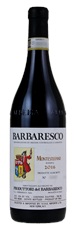
A beam of cherry, strawberry and rose aromas and flavors permeates this vibrant red. Hints of thyme, menthol and tar add depth as this builds to a long, resonant finish. Shows fine energy and intensity on a slim frame.
Barbaresco is one of the two most acclaimed DOCGs in Piedmont, the other being Barolo. Located just a few miles north of Barolo, Barbaresco is a small town of fewer than 700 people and 1,680 vineyard acres, making it less than half the size of the Barolo DOCG. The other communes in this DOCG of rolling hills are Neive and Treiso. As in Barolo, the DOCG requires that Barbaresco DOCG wines be 100% Nebbiolo, a grape thought of as the Pinot Noir of Italy. Records show that Nebbiolo was grown in the Piedmont as early as the 14th century, and despite being somewhat finicky – it is late to ripen and easily damaged by adverse weather --- Nebbiolo makes highly aromatic and powerful red wines. Until the mid-19th century Nebbiolos of Piedmont were vinified as sweet wines, though that ended in the late 19th century when a French oenologist was invited to Piedmont to show producers how to make dry reds. By the late 20th century respected producers were making outstanding Nebbiolos, as well as Nebbiolo blends that do not carry the DOCG label. Barbaresco was made a DOC in 1966 and upgraded to a DCOG in 1980. DOCG Barbaresco must be aged a minimum of two years, with a minimum of one year in wood. Barbarescos are regarded as more subtle and refined than Barolos, and more approachable when young.
This red grape is most often associated with Piedmont, where it becomes DOCG Barolo and Barbaresco, among others. Its name comes from Italian for “fog,” which descends over the region at harvest. The fruit also gains a foggy white veil when mature.


 Preferred storage and shipping partner of
 Share
Share
 Post
Post
 Tweet
Tweet
 Copy Link




 <
<
 >
> service@winebid.com
 (888) 638-8968