Sign In

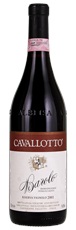
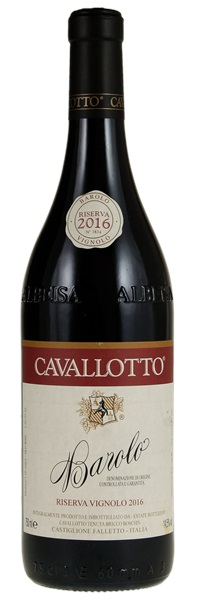
2016 Cavallotto Barolo Vignolo Riserva

2 available
Minimum Bid Per Bottle is $110
Ends Sunday, 7pm Pacific

ITEM 10629378 - Removed from a professional wine storage facility; Purchased at retail
Bidder Quantity Amount Total
2 $110
Item Sold Amount Date
I10349057 3 $110 Sep 7, 2025
2016 Cavallotto Barolo Vignolo Riserva

RATINGS

99Wine Enthusiast

Enticing aromas recalling new leather, pressed rose, eucalyptus and sandalwood come to the forefront on this gorgeous, compelling wine. Full-bodied, structured and loaded with finesse, the precise palate is young but already delicious, delivering juicy Marasca cherry, raspberry, licorice, truffle and white pepper alongside a backbone of taut, refined tannins.

97Wine Spectator

The volume of fruit is turned up in this red, revealing macerated cherry, raspberry and plum notes, with menthol, iron and tar elements adding depth. Solidly built, with fine tension and a complex, detailed aftertaste.

96+ The Wine Advocate

...organic wine that shows superb balance and great intensity. Elegance and power are in fact the twofold hallmark of this iconic vintage...polished and silky wine with an almost glossy or latex-like quality to its tannins...

94Vinous / IWC

Red cherry, iron, incense, white pepper, cedar and tobacco are enshrouded by a blanket of intense tannin. The flavor profile is decidedly old-school leaning, in a way that is not too common these days. Firm, dusty tannins wrap it all together.

92James Suckling

A firm and linear red with cedar, nuts and berries on the palate. Hints of sandalwood. Medium-bodied. Chewy yet caressing.

17.5Jancis Robinson

Cool spicy nose that is still a little shy on the nose and with mineral notes. Crunchy juicy fruit on the palate, and still a little backward. Sour cherry and hints of orange peel, energetic acidity and finely ground tannins and a long sweet-sour cherry finish.

PRODUCER

Cavallotto

Cavallotto is a 64-acre estate in Bricco Boschis in the heart of the Barolo region in Piedmont. The estate’s roots go to the early 20th century, when Giuseppe Cavallotto ran the vineyards for the region’s most prominent landowner, the countess Juliette Colbert. Cavallotto managed to buy property and in 1948 his sons started making wine under their own family label. Today the fourth and fifth generations of the family run the estate. Cavallotto produces about 100,000 bottles annually and is known for its Barolos. Gambero Rosso has written that Cavallotto’s “Barolo selections are among the best in the designation.” The estate also produces Barbera, Nebbiolo, Dolcetto and several white wines.

REGION

Italy, Piedmont, Barolo

Barolo is one of Italy’s greatest wine appellations. In fact many cognoscenti of Italian wines consider Barolo to be the apex of Italian winemaking. Barolo is sometimes referred to as “the king of wines, and the wine of kings” partly because until the mid-19th century Piedmont was owned by the noble House of Savoy, the historic rulers of northwestern Italy. And the Savoys had a taste for Nebbiolo. Nestled into the rolling hills of Langhe, the Barolo DOCG includes 11 communes, one of which is the town of Barolo. There are 4,200 vineyard acres in the appellation and since the late 19th century growers have tried to identify their best vineyards. By marketing some vineyards as better quality than others, Barolo producers have followed the Burgundian custom of making single vineyard, or “cru” vineyard bottlings. As in neighboring Barbaresco, the Barolo DOCG requires that wines be 100% Nebbiolo, a grape thought of as the Pinot Noir of Italy. Records show that Nebbiolo was grown in the Piedmont as early as the 14th century, and despite being somewhat finicky – it is late to ripen and easily damaged by adverse weather --- Nebbiolo makes highly aromatic and powerful red wines. Until the mid-19th century Nebbiolos of Piedmont were vinified as sweet wines, though that ended in the late 19th century when a French oenologist was invited to Piedmont to show producers how to make dry reds. Barolo was made a DOC in 1966 and upgraded to DOCG status in 1980. Barolos must be aged at least three years, at least two of those years in wood. Barolos are tannic and robust and generally need at least five years to soften into complex, earthy wines.

TYPE

Red Wine, Nebbiolo, D.O.C.G.

This red grape is most often associated with Piedmont, where it becomes DOCG Barolo and Barbaresco, among others. Its name comes from Italian for “fog,” which descends over the region at harvest. The fruit also gains a foggy white veil when mature.