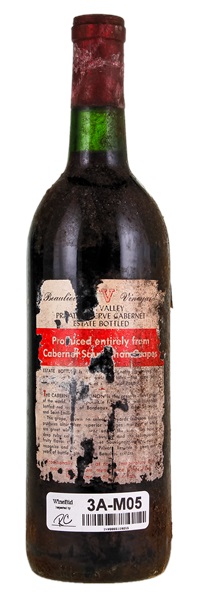
Founded in 1900 by Georges de Latour, a native of France, and led for many years by the legendary winemaker Andre Tchelistcheff, Beaulieu Vineyard has one of the oldest and most romantic histories in the Napa Valley. De Latour bought his first vineyard in Rutherford and named it “beau lieu,” French for "beautiful place.” His vision was to create a serene wine chateau and the estate is still one of the most scenic in the region. Beaulieu’s Private Reserve Cabernet Sauvignon dates back to the 1930s, and it quickly became one of California’s premier wines. Tchelistcheff, trained as a wine master in France, shaped the character of BV’s wines during the 1950s and 1960s. Today the winery is still famous for its BV Georges de Latour Private Reserve, but also makes Merlot, Chardonnay, Pinot Noir, Sauvignon Blanc and Zinfandel, thanks in part to the acquisition of vineyards in other parts of Napa Valley. Altogether the winery owns 1,029 acres and produces a total of 750,000 bottles a year.
Napa Valley AVA is the most famous winemaking region in the United States and one of the most prestigious in the world. With nearly 43,000 acres of vineyards and more than 300 wineries, it is the heart of fine wine production in the United States. Winemaking started in Napa in 1838 when George C. Yount planted grapes and began producing wine commercially. Other winemaking pioneers followed in the late 19th century, including the founders of Charles Krug, Schramsberg, Inglenook and Beaulieu Vineyards. An infestation of phylloxera, an insect that attacks vine roots, and the onset of Prohibition nearly wiped out the nascent Napa wine industry in the early 20th century. But by the late 1950s and early 1960s Robert Mondavi and other visionaries were producing quality wines easily distinguishable from the mass-produced jug wines made in California’s Central Valley. Napa Valley’s AVA was established in 1983, and today there are 16 sub-appellations within the Napa Valley AVA. Many grapes grow well in Napa’s Mediterranean climate, but the region is best known for Cabernet Sauvignon. Chardonnay is also very successfully cultivated, and about 30% of the AVA’s acreage is planted to white grapes, with the majority of those grapes being Chardonnay,
One of the most widely grown grape varieties, it can be found in nearly every wine growing region. A cross between Cabernet Franc and Sauvignon Blanc. It’s a hardy vine that produces a full-bodied wine with high tannins and great aging potential.


 Preferred storage and shipping partner of
 Share
Share
 Post
Post
 Tweet
Tweet
 Copy Link




 <
<
 >
> service@winebid.com
 (888) 638-8968