Sign In

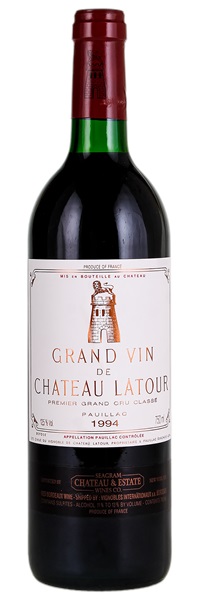
1994 Château Latour

Light capsule condition issue; base neck fill; light label condition issue

Minimum Bid is $360
Ends Sunday, 7pm Pacific

ITEM 10554152 - Removed from a professional wine storage facility; Purchased upon release at retail
Bidder Amount Total
$360
Item Sold Amount Date
I10462364 4 $360 Oct 26, 2025
I10437358 1 $360 Oct 19, 2025
I10328375 1 $360 Aug 24, 2025
I10316628 1 $360 Aug 24, 2025
I10213831 1 $400 Jul 6, 2025
I10198415 1 $420 Jun 29, 2025
1994 Château Latour

RATINGS

94Robert M. Parker Jr.

...intense textbook nose of walnut and cassis scents complemented by smoky pain grille notes that build in the glass. This full-bodied, powerful, layered Latour reveals high tannin, but no bitterness or astringency...

91Wine Spectator

Classic Cabernet style. Intense aromas of plums and cherries, with hints of new wood. Full-bodied, with juicy and ripe tannins and a long finish. Very well-structured.

16Jancis Robinson

PRODUCER

Château Latour

Château Latour’s long and noble history is summarized graphically on every bottle. The label shows the domaine’s famous tower, a symbol of the château's importance to regional politics and defense as early as the 14th century. And as one of the original four First Growth Bordeaux, the estate has become even more significant in the last 200 years as the producer of one of the world’s most legendary wines. Robert M. Parker Jr. has noted that the wine produced at Château Latour “has been an impeccable model of consistent excellence in great, mediocre and poor vintages.” After passing to British ownership from 1963 to 1993, the château was purchased in 1993 by Francois Pinault, one of France’s most successful businessmen and entrepreneurs. Vineyards total 163 acres, with 75% planted to Cabernet Sauvignon, 4% to Cabernet Franc, 20% to Merlot, and 1% Petit Verdot. The average age of the vines is 60 years. The chateau produces 180,000 bottles of Château Latour annually.

REGION

France, Bordeaux, Pauillac

Pauillac is Bordeaux’s most famous appellation, thanks to the fact that it is home to three of the region’s fabled first-growth châteaux, Lafite-Rothschild, Mouton-Rothschild and Latour. Perched on the left bank of the Gironde River north of the city of Bordeaux, Pauillac is centered around the commune of Pauillac and includes about 3,000 acres of vineyards. The Bordeaux classification of 1855 named 18 classified growths, including the three above mentioned First Growths. Cabernet Sauvignon is the principal grape grown, followed by Merlot. The soil is mostly sandy gravel mixed with marl and iron. Robert M. Parker Jr. has written that “the textbook Pauillac would tend to have a rich, full-bodied texture, a distinctive bouquet of black currants, licorice and cedary scents, and excellent aging potential.”