Sign In

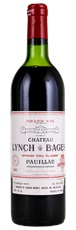
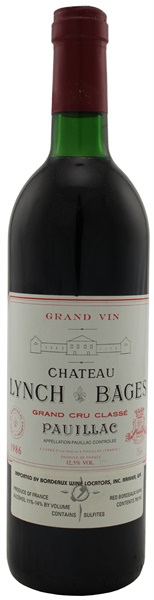
1986 Château Lynch-Bages

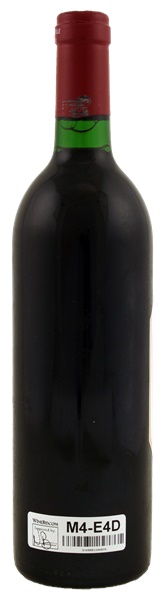
Light capsule condition issue; light signs of past seepage; base neck fill; light label condition issue

Removed from protected passive storage in a temperature controlled home; Purchased at retail
Ends Sunday, 7pm Pacific

RATINGS

94The Wine Advocate

...has a knockout bouquet that wraps its arms around you with all its loveliness: pure black cherries, mint and cedar... Vibrant...palate is beautifully balanced, crisp and taut, linear but very precise with a fine bead of acidity...the intensity of fruit that seems undiminished on the finish.

94Vinous / IWC

...attractive nose with blackberry, melted asphalt, mint and a hint of gravel in the background...medium-bodied with fine tannins...powerful...

92.2CellarTracker

90Wine Spectator

...intense aromas of ripe black cherry, cedar and light herbs. Medium- to full-bodied, with firm tannins and a medium finish.

17.5Jancis Robinson

Fully evolved nose and massively flattering richness on the palate... Spicy and broad and persistent. Really rather delicious! With a hint of graphite. A very good bottle. Chock-full of fruit and character...

**/**Michael Broadbent

...impressively deep...fleshy, ripe, leathery, cedar and 'cheese rind' bouquet.

PRODUCER

Château Lynch-Bages

Château Lynch-Bages gets its name form its 17th century founder, Thomas Lynch, whose father emigrated from Ireland in 1691 to Bordeaux. Thomas Lynch married a woman in the village of Bages who inherited the estate that is now Château Lynch-Bages. In the 18th and 19th centuries the estate was bought and sold several times, but in 1937 it was purchased by the grandfather of the current owner, who is is Jean-Michel Cazes. In the 1950s and 1960s the wines of Château Lynch-Bages were some of the most heralded of Pauillac and Jean-Michel has continued to focus on quality. Although Château Lynch-Bages is a Fifth Growth Bordeaux according to the 1855 classification, most reviewers say the château’s wines are much closer to the quality of Second Growth wines. The estate includes 235 acres planted to 73% Cabernet Sauvignon, 10% Cabernet Franc, 14% Merlot and 2% Petit Verdot. Vines are 35 years old, on average, and 38,000 cases are produced annually.

REGION

France, Bordeaux, Pauillac

Pauillac is Bordeaux’s most famous appellation, thanks to the fact that it is home to three of the region’s fabled first-growth châteaux, Lafite-Rothschild, Mouton-Rothschild and Latour. Perched on the left bank of the Gironde River north of the city of Bordeaux, Pauillac is centered around the commune of Pauillac and includes about 3,000 acres of vineyards. The Bordeaux classification of 1855 named 18 classified growths, including the three above mentioned First Growths. Cabernet Sauvignon is the principal grape grown, followed by Merlot. The soil is mostly sandy gravel mixed with marl and iron. Robert M. Parker Jr. has written that “the textbook Pauillac would tend to have a rich, full-bodied texture, a distinctive bouquet of black currants, licorice and cedary scents, and excellent aging potential.”

VINTAGE

1986 Château Lynch-Bages