Sign In

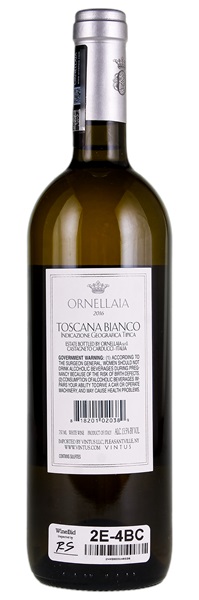
2016 Tenuta Dell'Ornellaia Ornellaia Bianco

Minimum Bid is $210
Ends Sunday, 7pm Pacific

ITEM 10552272 - Removed from a professional wine storage facility; Purchased from a private collector

Bidder Amount Total
$210
Item Sold Amount Date
I10533253 2 $210 Dec 14, 2025
2016 Tenuta Dell'Ornellaia Ornellaia Bianco

RATINGS

99James Suckling

...fantastic... Very complex and dense yet, at the same time, energetic and vivid...shows so much richness and density with a pretty, phenolic texture that keeps you entranced. Full-bodied with lots of honeysuckle, green-melon and cooked-apple character. Very long and flavorful.

98Jeb Dunnuck

...incredible purity, precision, and length, displaying notes of clean citrus, melon, white flowers, and honeyed minerality. Fresh and vibrant as well as rich and powerful, it's medium-bodied, seamless, and flawlessly balanced on the palate, with a thrilling finish.

95The Wine Advocate

...white rose, crisp apple, saffron, toasted pine nut, cinnamon and wild sage. The aromas show brilliant detailing...expansive and creamy in terms of mouthfeel...generous and rich...spicy endnotes serve to frame the beautiful fruit that sits squarely at center stage.

93-95Vinous / IWC

90Wine Spectator

...spicy, buttery...displaying melon, apple, lanolin and vanilla flavors. Compact on the finish, revealing mineral and smoke elements.

16.5+ Jancis Robinson

PRODUCER

Tenuta Dell'Ornellaia

Tenuta Dell’Ornellaia was founded by Lodovico Antinori in 1981 in Bolgheri, on the Tuscan coast. Antinori, who comes from the legendary Antinori winemaking family of Florence, wanted to make a Super Tuscan of extraordinary quality. He succeeded with his two premier wines, Ornellaia and Masseto. The Masseto is nearly 100% Merlot and Ornellaia is a more typical Bordeaux-style blend of Cabernet Sauvignon, Cabernet Franc and Petit Verdot. Tenuta Dell’Ornellaia was bought by Robert Mondavi Corp. in 2001, and the Mondavi Corp. was then bought by Constellation Brands. Since then the Frescobaldi winemaking family of Florence has been trying to acquire controlling interest in the winery. Tenuta Dell’Ornellaia owns 160 acres of vineyards planted to Cabernet Sauvignon, Merlot and Cabernet Franc. The average age of the vines is 20 to 25 years. Annual production of Ornellaia is 8,000 – 12,500 cases. Annual production of Masseto is 2,000 to 2,400 cases.

REGION

Italy, Tuscany

Tuscany, or Toscana in Italian, is Italy’s best-known wine region and its most diverse. Historically Sangiovese was the primary grape grown in Tuscany and Chianti was considered the purest expression of Sangiovese. Sangiovese and its many clones are still important, and they are the grapes used for the Tuscan appellations of Brunello di Montalcino, Vino Nobile di Montepulciano, Morellino di Scansano, Chianti, Chianti Classico and Carmignano. But in the last 50 years innovative producers, many of them in southwestern Tuscany in the area called Maremma, have also planted Cabernet Sauvignon, Merlot, and Cabernet Franc. The tradition defying producers have blended those varietals with Sangiovese to produce dazzling wines that do not conform to Italy’s appellation regulations. Such wines are called Super Tuscans and cannot be labeled with either of Italy’s highest level quality designations, which are in order of status Denominazione di Origine Controllata e Garantia, (DOCG), and Denominazione di Origine Controllata, (DOC). (This has not at all hindered the demand for Super Tuscans, some of which are consistently among the world’s most admired and well-reviewed wines.) Tuscany has six DOCG appellations and thirty-four DOCs. Though famous for its red wines, Tuscany also produces whites made primarily from Trebbiano and Vernaccia. There are also many Tuscan Indicazione Geographica Tipica (IGT) wines that are often an innovative blend of traditional and non-traditional grapes. This relatively new appellation status was started in 1992 as an attempt to give an official classification to Italy’s many newer blends that do fit the strict requirements of DOC and DOCG classifications. IGT wines may use the name of the region and varietal on their label or in their name.