Sign In

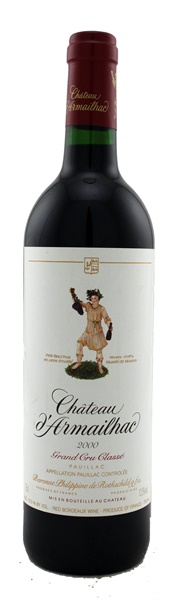
2000 Château d'Armailhac

Minimum Bid is $71
Ends Sunday, 7pm Pacific

ITEM 10544064 - Removed from a professional wine storage facility; Obtained by inheritance; Consignor is second owner
Bidder Amount Total
yanch0 $70 $70
$70
Item Sold Amount Date
I10526932 1 $70 Dec 7, 2025
I10494998 1 $75 Nov 16, 2025
I10473444 1 $75 Nov 2, 2025
I10461972 2 $75 Oct 26, 2025
I10326876 1 $71 Aug 24, 2025
I10296636 1 $70 Aug 17, 2025
2000 Château d'Armailhac

RATINGS

90Wine Spectator

Juicy red. Plenty of tobacco, berry and currant character in this. Medium-bodied, with fine tannins and a long finish.

88-90Stephen Tanzer

****Decanter Magazine (stars)

Fat, ripe, good weight of fruit. Sweet fruit, lots of cassis. Chocolate. Elegant fruit wieght, depth of flavour and character. Long. Drink 10+ years....

PRODUCER

Château d'Armailhac

Château d’Armailhac is a Fifth Growth Estate in the Pauillac appellation of Bordeaux. The 126-acre estate has a complicated history and was renamed three times in the 20th century. From the 17th century until 1955 it was known as Château Mouton d’Armailhac. In 1933 it was purchased by Baron Philippe de Rothschild. The Baron renamed it Mouton-Baron-Philippe in 1956, and in 1975 changed it to Mouton-Baronne-Philippe, to honor his wife. Since 1989 it has once again been called Château d’Armailhac. The de Rothschild family also owns Mouton Rothschild and Clerc Milon. Château d’Armailhac is planted to 56% Cabernet Sauvignon, 22% Merlot, 20% Cabernet Franc and 2% Petit Verdot. Some 220,000 bottles are produced each year.

REGION

France, Bordeaux, Pauillac

Pauillac is Bordeaux’s most famous appellation, thanks to the fact that it is home to three of the region’s fabled first-growth châteaux, Lafite-Rothschild, Mouton-Rothschild and Latour. Perched on the left bank of the Gironde River north of the city of Bordeaux, Pauillac is centered around the commune of Pauillac and includes about 3,000 acres of vineyards. The Bordeaux classification of 1855 named 18 classified growths, including the three above mentioned First Growths. Cabernet Sauvignon is the principal grape grown, followed by Merlot. The soil is mostly sandy gravel mixed with marl and iron. Robert M. Parker Jr. has written that “the textbook Pauillac would tend to have a rich, full-bodied texture, a distinctive bouquet of black currants, licorice and cedary scents, and excellent aging potential.”