Sign In

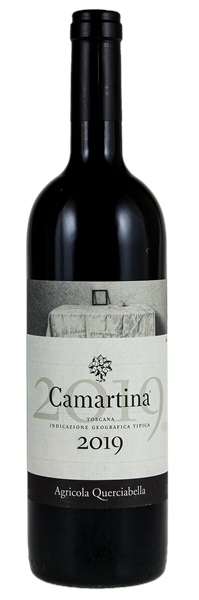
2019 Querciabella Camartina

Removed from a professional wine storage facility

9 available
Bid *

Elevated cork

Removed from a professional wine storage facility

Lightly elevated cork

Removed from a professional wine storage facility

Ends Sunday, 7pm Pacific

RATINGS

98James Suckling

Perfumed and classy with fresh thyme and currants with some lead pencil. Medium-bodied with very crunchy fruit and a bright and energetic finish. Lively acidity frames the wine with fine tannins. Shows brightness and vivacity.

96Wine Enthusiast

The nose starts off spicy and meaty, full of cracked pepper and gunpowder, before turning herbal, with notes of coriander seed, fennel and cherry. The cherry shines on the palate, above earthy and bitter undertones, and the fennel returns for the finish. Firm but lithe tannins and confident acidity are present, making for an accomplished dancer.

95Vinous / IWC

...dense, powerful wine... Dark red fruit, mocha, new leather blood orange and sweet spice all take shape in the glass.

94The Wine Advocate

...shows dark fruit nuances with savory tobacco and spice. This wine is mostly driven by the heft and concentration of the French grape, but it also shows some of the bright cherry and freshness of the Italian grape.

94Wine Spectator

Fresh and infused with black currant, cherry, plum, iron and underbrush flavors. Beautifully balanced, this firms up on the finish, yet reveals requisite fruit to shine through on the long aftertaste.

94Jeb Dunnuck

...notes of fresh blackberry, mossy forest earth, and graphite. It’s full-bodied without being heavy and has a refined and elegant feel, with a backbone of Sangiovese to keep things more linear, ripe tannins, and a clean finish with good length.

PRODUCER

Querciabella

Querciabella was established in 1974 and is today owned by Sebastiano Cossia Castiglioni, an entrepreneur with a background in business, industrial design, real estate and sustainable agriculture. The estate was an early adopter of biodynamic winemaking and has been chemical-free since 1988. Its 183 vineyard acres are in Greve, Panzano, Radda and Gaiole, prime Chianti Classico territory. Querciabella, which means “beautiful oak tree,” also owns 79 vineyard acres in Maremma on the Tuscan coast. The estate produces five wines from the Chianti Classico zone, including white and red blends. The estate’s DOCG wine is the flagship Querciabella 100% Sangiovese. The estate also produces red blends in the Maremma and a Cabernet Franc/Syrah/Merlot blend called Turpino from Maremma and Chianti fruit. Castiglioni’s approach to non-traditional blends makes him part of a modern Italian winemaking trend that eschews sticking strictly to traditional appellation regulations regarding blending and the use of non-traditional grapes. Vinous has complimented Castiglioni “for being the first Chianti Classico producer to make a concerted effort to showcase the personalities of specific sites: the quest to explore and understand the uniqueness of various sites, and to bottle wines from those vineyards so that we might understand their intrinsic qualities.”

REGION

Italy, Tuscany

Tuscany, or Toscana in Italian, is Italy’s best-known wine region and its most diverse. Historically Sangiovese was the primary grape grown in Tuscany and Chianti was considered the purest expression of Sangiovese. Sangiovese and its many clones are still important, and they are the grapes used for the Tuscan appellations of Brunello di Montalcino, Vino Nobile di Montepulciano, Morellino di Scansano, Chianti, Chianti Classico and Carmignano. But in the last 50 years innovative producers, many of them in southwestern Tuscany in the area called Maremma, have also planted Cabernet Sauvignon, Merlot, and Cabernet Franc. The tradition defying producers have blended those varietals with Sangiovese to produce dazzling wines that do not conform to Italy’s appellation regulations. Such wines are called Super Tuscans and cannot be labeled with either of Italy’s highest level quality designations, which are in order of status Denominazione di Origine Controllata e Garantia, (DOCG), and Denominazione di Origine Controllata, (DOC). (This has not at all hindered the demand for Super Tuscans, some of which are consistently among the world’s most admired and well-reviewed wines.) Tuscany has six DOCG appellations and thirty-four DOCs. Though famous for its red wines, Tuscany also produces whites made primarily from Trebbiano and Vernaccia. There are also many Tuscan Indicazione Geographica Tipica (IGT) wines that are often an innovative blend of traditional and non-traditional grapes. This relatively new appellation status was started in 1992 as an attempt to give an official classification to Italy’s many newer blends that do fit the strict requirements of DOC and DOCG classifications. IGT wines may use the name of the region and varietal on their label or in their name.

VINTAGE

2019 Querciabella Camartina